sales4@yodeldrag.com
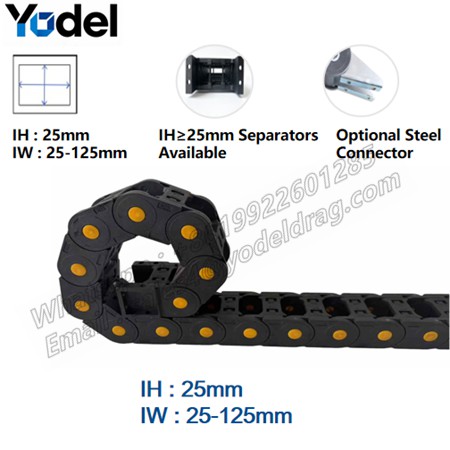
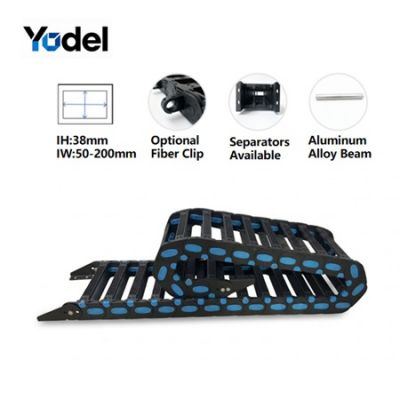
In dynamic multi-axis automation, standard unreinforced tracks often flex or experience premature link joint wear under continuous speed. Our 25mm inner-height plastic cable carrier engineering line combines pure Polyamide 66 (PA66) matrix resin with high-tensile glass fiber reinforcement. This specialized composite formulation imparts exceptional structural rigidity, minimal thermal creep, and long-term tensile endurance, allowing every plastic cable carrier to function effortlessly in temperatures spanning -40°C to +120°C.
By eliminating mid-span sagging during long travel paths, this high-rigidity plastic cable carrier guarantees predictable horizontal movement, protecting fragile wiring against dynamic tension spikes and friction abrasion.
Field inspections, hose replacements, and wire retrofits in industrial plant environments often stall production when using enclosed carriers. Built with an openable bridge geometry, this plastic cable carrier incorporates quick-release crossbars accessible from either the inner or outer bend radius.
Maintenance personnel can unlatch individual crossbars using a standard flathead screwdriver, placing fully pre-assembled wire harnesses directly into the cavity. The open bridge design accelerates air circulation around working motor leads while providing a natural path for light dust or machining debris to drop out without grinding inside the track.
Dynamic acceleration generates intense shear torque at anchor connection points. To eliminate mounting deformation, our plastic cable carrier system supports optional high-strength steel end brackets precision-machined to distribute mechanical stresses evenly across gantry frames.
For complex internal cable management, we provide specialized modular internal accessories:
Vertical Compartment Separators: Slide-in vertical dividers isolate high-voltage power lines from delicate encoder wiring inside the plastic cable carrier, eliminating line rubbing and electrical noise crosstalk.
Integrated Fiber Optic Clips: Sensitive glass fiber cables require constant bend control without mechanical compression. Specialized fiber clips snap securely into the plastic cable carrier, anchoring optical conductors without pinching their protective jacket.
A specialized CNC routing OEM experienced recurring bracket fatigue and optical signal distortion during 1.5G gantry acceleration moves. Swapping out generic plastic tracks for our glass-fiber reinforced plastic cable carrier equipped with steel end connectors, internal vertical dividers, and optical fiber clips completely eliminated connection play. Equipment operational vibration diminished, and optical signal dropouts ceased entirely.
Selecting correct geometric parameters ensures long-term fatigue life for your plastic cable carrier:
Calculate Clearance Margin:
Formula: Max Cable Diameter = Inner Height (25mm)×85%
Rule: Max individual conductor or hose outer diameter must not exceed 21.25mm (recommended 21mm).
Select Bending Radius (R55, R75, R100, R125, R150, R200mm):
Tight Enclosures: Deploy smaller bend profiles (R55/R75) inside tight machine housings.
Thick Power Conduits: Utilize wider bend profiles (R150/R200) inside the plastic cable carrier to minimize internal flexing stress on heavy copper cores.
Q1: Why choose a PA66 glass fiber reinforced plastic cable carrier over plain nylon tracks?
A: Adding glass fiber to virgin PA66 significantly elevates tensile strength, flexural modulus, and heat distortion limits. This composite plastic cable carrier resists sag over longer unsupported spans and maintains link integrity under high acceleration.
Q2: How do vertical separators and fiber optic clips improve plastic cable carrier performance?
A: Vertical separators prevent heavy motor leads from twisting around thin control wires, preventing insulation friction. Fiber optic clips hold delicate glass fiber lines firmly inside the plastic cable carrier without applying pinching pressure that disrupts signal transmission.
Q3: Can this plastic cable carrier be retrofitted with steel end brackets later?
A: Yes. The mounting interfaces are designed modularly, allowing you to swap standard plastic end links for high-strength steel end connectors whenever your machinery demands higher mounting anchoring strength.
Yodel Technology Development Co., Ltd. is a professional cable carrier manufacturer in China with 15+ years of industry expertise, dedicated to providing various types, high-quality and cost-effective fastening solutions to global customers.[read more]


Contact Person : Tinny Tan
Te l : 8619922601285
E-mail : sales4@yodeldrag.com
Add : Chengnan Development Zone, Yanshan County, Hebei Province